Looking for Professional Aviation Training? Explore Havoc Aviation →
Aeromodelling Hero Background

AEROMODELLING &
RC AIRCRAFT

Build Understand Configure Simulate Fly

Recommended Age: 8–16 Years

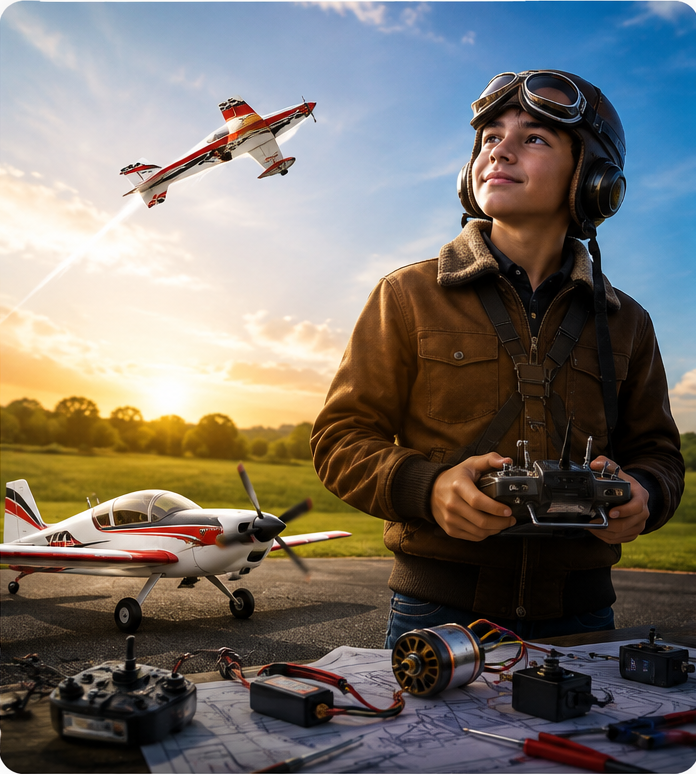
Explore the exciting world of aeromodelling and RC aviation through practical, hands-on learning. Students learn how RC aircraft work, how they are built and configured, how their electronic systems operate, and how to safely progress from simulator practice to practical RC flying.

01 COURSE OVERVIEW

From Building Aircraft to Flying Them

This program introduces young aspirants to the fundamentals of aeromodelling and RC aviation, progressively developing their understanding of different aircraft types, construction techniques, electronics, simulation and practical flying.

Students don't simply learn how to operate a ready-made model. They are introduced to how an RC aircraft is designed, built, assembled, configured, maintained and safely operated.

Understand the aircraft from the inside out — then learn to fly it.

The program can progress according to the student's age, experience, skill level, learning progress and safety considerations.

Understand
Build
Configure
Simulate
Fly
Advance

02 EXPLORE DIFFERENT TYPES OF RC AIRCRAFT

Aircraft & Aeromodelling Fundamentals

Students are introduced to different categories of RC aircraft, progressing according to their experience and skill level.

Students learn the basic principles behind each type of aircraft, including construction, power systems, controls, electronics and operating characteristics.

03 RC AIRCRAFT BUILDING & ASSEMBLY

Build It. Understand It.

Students learn how RC aircraft are constructed and assembled through both commercially available kits and scratch-building activities.

Ready DIY Kits

Assemble kits, set up components and complete the aircraft for operation.

Scratch Building

Build from drawings, plans and materials using original designs and techniques.

Construction Skills

Learn airframe, wings, linkages, electronics, power-systems, balancing and more.

The objective is to help students understand how an aircraft is constructed rather than simply operating a ready-made model.

04 RC ELECTRONICS & SYSTEM CONFIGURATION

Understand What Makes the Aircraft Work

Practical exposure to electrical and electronic systems used in RC models.

Understand how components work together and how a complete RC system is correctly configured.

05 RC FLIGHT SIMULATOR TRAINING

Learn Before You Fly

Develop coordination, orientation and aircraft-control skills in a controlled simulator environment.

Simulator practice builds coordination, confidence and control skills before progressing to real RC aircraft.

06 RC FLYING COACHING & TRAINING

From Simulator to
the Real Aircraft

Progress from theory and simulator practice to practical RC flying under supervision.

Advance from basic models to sophisticated RC aircraft based on ability, experience, age and safety.

07 LEARNING JOURNEY

BUILD CONFIGURE SIMULATE FLY ADVANCE
01

Discover

Understand aeromodelling and different types of RC aircraft.

02

Build

Learn aircraft construction, assembly and scratch-building.

04

Simulate

Develop orientation and control skills through RC flight simulation.

06

Advance

Move towards more sophisticated aircraft as per ability.

08 WHAT STUDENTS DEVELOP

Skills Beyond Flying

Technical Understanding

Understand aircraft construction, systems, electronics and operation.

Practical Skills

Build, assemble, configure and maintain RC aircraft.

Coordination & Control

Develop orientation, transmitter handling and aircraft-control skills.

Problem Solving

Develop basic troubleshooting and maintenance skills.

Aviation Awareness

Early introduction to aircraft, flight principles and aviation.

Safety Awareness

Understand preparation, inspection and safe operation.

Encouraging curiosity, technical understanding, practical skills, coordination and a passion for aviation and motorsport from an early age.

09 WHO IS THIS PROGRAM FOR?

Foundation Course for Young Aspirants

Recommended Age: 8–16 Years

For students interested in:

  • Aeromodelling
  • RC Aircraft
  • Aircraft Building
  • Electronics
  • Flight Simulation
  • RC Flying
  • Aviation

10 IT'S MORE THAN FLYING AN RC AIRCRAFT

At HAVOC EFS, students don't simply learn to operate an RC aircraft. They learn to understand how it is designed, built, assembled, configured, maintained and safely operated.

  • BUILD Learn how aircraft are constructed.
  • UNDERSTAND Explore aircraft systems and components.
  • CONFIGURE Set up electronics, controls and power systems.
  • SIMULATE Develop control skills in a controlled environment.
  • FLY Progress to practical RC flying.
  • ADVANCE Explore increasingly sophisticated aircraft.

11 COURSE STRUCTURE / MODULES

01 Aircraft & Aeromodelling
Students are introduced to different categories of RC aircraft, including basic gliders, electric models, nitro and jet turbines. Focus is on principles behind each type.
02 Aircraft Building & Assembly
Hands-on experience with commercially available kits and scratch-building activities. Covers airframe construction, linkages, balancing, and material selection.
03 RC Electronics & Configuration
Practical exposure to electric motors, ESCs, servos, batteries, power distribution, and radio programming configuration.
04 RC Flight Simulator Training
Develop orientation, transmitter handling, take-off, circuits, and emergency recovery safely in a controlled simulator environment.
05 RC Flying Coaching
Progressing from simulator to real aircraft under proper instructor supervision, learning pre-flight checks, ground control, and basic flight manoeuvres.
06 Advanced RC Aircraft
Progression towards sophisticated and complex RC aircraft models as per student ability, safety considerations, and experience.

12 SAFETY & PROGRESSION

All RC flying, model operation, simulator activities and practical sessions are conducted subject to applicable laws and regulations, permitted locations, safety requirements, instructor supervision, student ability and equipment suitability.

Progression to advanced models and power systems is based on the student's ability, experience, age, instructor assessment and applicable safety considerations.

13 Ready to Take Off?

Start your journey into aeromodelling and RC aviation.